
Submitted by C. Todd Lopez, Pentagon
June 11, 2026, 12:51 pm
 |
|---|
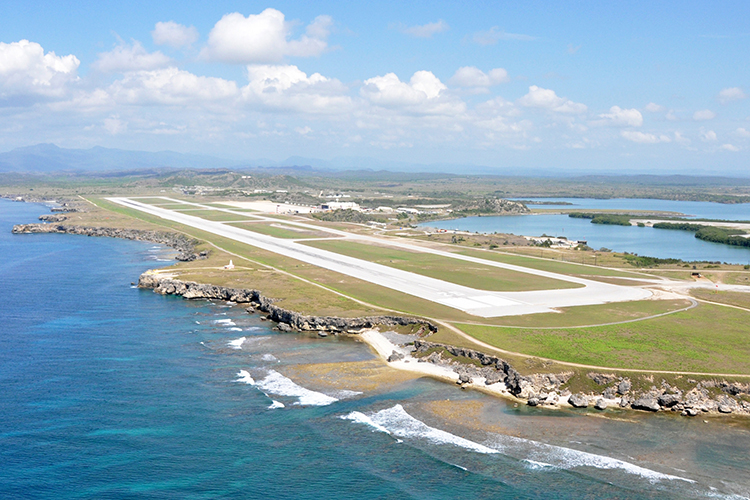
An aerial view of the Leeward Airfield at Naval Station Guantanamo Bay, Cuba, May 6, 2010. Image by Navy Chief Petty Officer Bill Mesta |
At Naval Station Guantanamo Bay, Cuba, Secretary of War Pete Hegseth met with service members for a morning physical training session and also discussed readiness with mission leaders at the installation.
"What happens with the future of Cuba is in the hands of the president of the United States and the leadership of Cuba," Hegseth said. "No matter what, the Department of War is going to be prepared and postured for any possible contingency."
Naval Station Guantanamo Bay is part of U.S. Southern Command and serves as a centerpiece for U.S. regional security in the Caribbean. It is home to about 3,000 U.S. military personnel and the Guantanamo Bay detention camp, responsible for the safe, humane, legal care and custody of law of armed conflict detainees.
Hegseth served at Guantanamo Bay two decades ago and told service members at the morning PT session that the mission today is as important as it was then.
"It's an honor to be here at Guantanamo Bay," he said. "I was here 20 years ago, serving as a soldier as part of the detention mission. This was then, and is here today, a very important and strategic piece of American terrain."
He noted that the visit served two purposes: to ensure the detention facility is strong and the service members are equipped, but also to show the world that U.S. military readiness does not just mean on the other side of the globe.
"[We want to make sure] the world understands that American might, whether it's 9,000 miles away or 90 miles away from our shores, is the greatest in the world, and [we are] prepared to go on offense or defense at any moment to defend our interests," he said.
In 1823, then-President James Monroe articulated a foreign policy, now known as the Monroe Doctrine, which declared that the western hemisphere was off-limits to further colonization efforts or interference by European nations. Later, that expanded to include interference by any foreign power.
In 1904, Hegseth said, President Theodore Roosevelt added to that doctrine his own take, known as the Roosevelt Corollary, which emphasized that the U.S. could intervene in the affairs of Latin American nations to protect U.S. interests.
Hegseth told soldiers that the Monroe Doctrine has been central to the history of the United States.
"We're defending the homeland, and we are taking back our hemisphere," he said. "This president came in and said not only is the Monroe Doctrine alive, and not only does the Roosevelt Corollary live, but now we have the 'Donroe Doctrine' — the [President Donald J.] Trump corollary to the Monroe Doctrine. That the territory, terrain in our hemisphere, is key terrain."
The secretary cited examples of this since Trump took office in 2025.
The U.S. is working with Panama to secure the Panama Canal for use first, by American nations — not by Chinese interlopers.
"We're working there to ensure that both sides of the canal are secure; that our ships flow freely," he said, adding that the U.S. is strengthening military-to-military partnerships with Panama, including a new jungle school there and an increased presence to ensure the two American continents are safe for the interests of American nations.
"We want to make sure foreign adversaries could not control that," he said.
Further south in Venezuela, Hegseth noted the January capture of Venezuelan leader Nicolás Maduro, who was brought to justice on multiple U.S. federal charges, including narco-terrorism and drug trafficking.
"He thought he could flaunt the United States of America," Hegseth said. "Then he found out [he could not], in about 45 minutes, in the middle of the night, in the most heavily fortified base inside their capital city."
During Operation Absolute Resolve, he said, U.S. forces performed exceptionally — an Army warrant officer even earned a Medal of Honor for actions during the raid.
"Russian air defenses and Cuban guards ... were no match for them ... our operators, our Rangers — those that do incredible things," Hegseth said.
With troops at Guantanamo Bay, Hegseth relayed a message from the president about top cover and support from a grateful nation.
"
He always wants me to tell you that he's got your back," Hegseth said of the president. "He's got your back in the circumstances that you need to undertake. ... Not everything's going to go right every single time, but if [you're] doing it for the right reasons, and on behalf of the country, we are going to untie your hands and unleash you to get it done, so that you come home and the bad guy doesn't — that's the point."
The secretary also recognized exemplary service members and thanked the families.
"
Let your families know we appreciate them, we support them, we love them," he said. "They serve with you — your wives, husbands, kids — they're in the fight with us. ... God bless you, keep going and stay ready."
