
By Michael Williams
Mar 19, 2026, 7:26 pm
 |
|---|
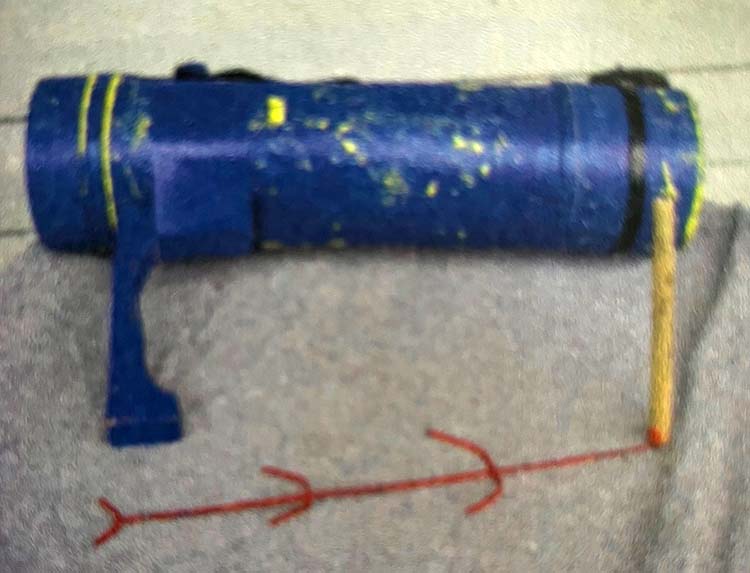
| The small rods on this antenna will indicate the race of a person buried in a grave. |
On a cool wintry day, Arthur Milo Bohannon stood on the side of the road, a stone’s throw away from McDonald’s on Straw Plains Pike. In each of his hands, he held an L-shaped rod. He held the rods up, and simultaneously the two instruments turned in an easterly direction.
“There is a cemetery in that direction,” he said. The instrument he held was reminiscent of a divining rod with which some mountain inhabitants used to detect water. But Bohannon isn’t seeking water. He is seeking lost cemeteries and forgotten graves. And his research has proven fruitful. His device has helped him uncover almost 6,000 lost graves.
 |
|
|---|---|
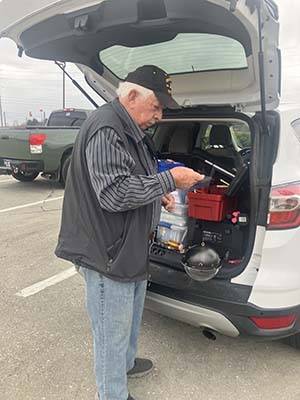
| Arthur Milo Bohannon |
Bohannon is a highly respected forensic scientist and has been inducted into the Inventors’ Hall of Fame for an earlier invention. His work has helped police solve numerous cases, and he got his start in forensics at an early age. In a scenario that sounds like an episode of the Hardy Boys, Bohannon was only 17 when police asked him to help solve a series of robberies.
As a teen, he ordered a fingerprint home study course from the Institute of Applied Science. He had seen it advertised in True Detective Magazine. The youth became adept at fingerprint analysis at an age when most police departments did not know the science.
In the early 1960s, Pigeon Forge was unincorporated. The town had one police officer. Mendel Collier worked as an auto body mechanic during the day and served as police chief at night. Like most police at the time, he had no formal training. There was no police academy, and the local police department had no fingerprint lab. At the time, forensic science was an emerging science. Like many small towns, it seemed as if everyone in Pigeon Forge knew one another. Collier heard about Bohannon’s skill and decided to seek out the inquisitive young man in hopes of gaining some insight into a fresh perspective on a series of robberies in the area.
“I was attending Sevier County High School in the early 1960s, and I was 17,” he said. “I had started studying fingerprints as a sophomore. Principal Jack Ogle called me to the office. When I got to the office, Chief Collier asked me about getting fingerprints. He had a suspect but needed more evidence.” Accompanied by Chief Collier, Bohannon went to the scene of the drive-in theater where the robbery had taken place. There he found a discarded cigarette butt. He was able to lift the prints off the butt and compare them to the suspect’s fingerprints. They matched, and it was all the evidence needed to get the 17-year-old suspect charged.
In court, the judge proved to be oblivious to the technology of fingerprinting and, on several occasions, questioned Bohannon’s expertise. Nonetheless, the case resulted in a conviction, and the two teens involved went to jail.
That was in 1962, a prodigious year for the local high school that was educating two rising stars. “Dolly Parton was one year behind me,” Bohannon said. “We would pass each other in the halls. It was unusual. She would leave school to play on Cas Walker’s radio show, and I would leave school to help solve crimes,” Bohannon noted.
“When Principal Ogle would call me over the intercom to come to the office, he would say, ‘Bring your bag.’ This was code for get ready to go to work,” Bohannon said.
Another memorable case he worked on in high school was a series of vandalism in Jones Cove. Using his magnifying glass and fingerprints he lifted from a damaged car, he was able to connect the suspect to the crime, and the 18-year-old offender was sent to prison.
After high school, he was recruited by the FBI, where he was sent to Washington, D.C. to perform fingerprinting. It was quite a culture shock for the small-town boy who left the bucolic setting of Pigeon Forge to live in a four-story apartment building in a large bustling city, where he had to take connecting buses to get to work.
He soon discovered he was on a short list of draftees to be sent to the escalating war in Vietnam. In an effort to get a more favorable assignment, he joined the Army and was soon sent to Arlington to guard the grave of President John F. Kennedy.
“At the time there was no slab on Kennedy’s grave but there was a flame,” Bohannon said. “There were some who believed he wasn’t dead and wanted to dig him up. So, we had to protect his grave.”
After three years in the Army, Bohannon returned home and went to work performing background checks for Oak Ridge during the week. On the weekends he worked for the sheriff of Jefferson County. In 1975, he went to work in Knoxville temporarily in the Knoxville crime lab. This “temporary job” continued for the next 25 years. Four techs were hired for the crime lab, with Bohannon being the only one in fingerprints. In Knoxville, he made connections at the University of Tennessee and with Knoxville law enforcement.
Bohannon earned a Bachelor’s degree from East Tennessee State University, an associate degree at Walters State, and a Doctorate at the International Hall of Fame Inventors Clubs of America, where actor Dennis Weaver inducted him.
Bohannon was recognized for his pioneering work in child fingerprints. At one time, investigators were baffled as to why prepubescent teens left no fingerprints. Bohannon’s research concluded that prepubescent kids leave water-based fingerprints. These water-based fingerprints evaporate after several hours. After puberty, teens and adults alike leave an oily fingerprint that can stay on a surface for years. He came to this conclusion after three years of research at his own expense. This discovery is being cited worldwide. Bohannon was named as a Keynote speaker in Anaheim, California, where he presented his findings.
His next major discovery was the Cyanoacrylate Blunt Contraption, also known as the CBC, which enabled Bohannon to extract fingerprints of murderers from their victims. The process involves melting Superglue into a liquid form, then blowing the liquid with a hose powered by a fan onto the murder victim. The glue will adhere to fingerprints left by the suspect, and investigators can photograph the prints. Bohannon earned a patent for the device, and it is now used in police departments around the globe. The device was first used in New Jersey, where A 7-year-old girl named Megan Kanka was abducted from her home and raped and murdered. Her body was discovered in a field. Bohannon donated a CBC device to investigators who used it to discover a handprint on the inside of the child’s thigh. This handprint resulted in the arrest and conviction of Jesse Timmendequas, a sex offender who had two previous convictions. This case resulted in many states passing Meghan’s Law, which requires sex offenders to be registered and the community to be notified of their presence.
When the World Trade Center was attacked on Sept. 11, 2001, Bohannon’s expertise was needed at the New York Medical Examiner’s office to assist in identifying human remains. As remains were brought from the rubble, he collected DNA samples. Bohannon identified thousands of body parts. His work was stressful, tedious, and physically costly. As a result, he now suffers from failing lungs due to exposure to chemicals from heavy metals, lead and other toxic chemicals.
“I was exposed to more than 27 toxic chemicals,” Bohannon recalled. “Of the four forensics specialists from East Tennessee, I am the last one left. To date, more than 15,000 people who worked the pile have died from exposure.”
Bohannon was tapped to photograph caskets that had been washed from cemeteries in the wakes of Hurricanes Floyd, Katrina, and Rita.
“My job was to photograph each casket and help identify the deceased so that their caskets and remains could be returned to their families for proper reburials,” Bohannon said. “Hurricane Floyd hit Tarboro, North Carolina, and washed up more than 400 caskets. When Katrina hit the coast, more than 1,200 caskets washed up. Many of the families would put their loved ones in new caskets and rebury them. One woman washed up twice. The first time when Katrina hit, and later when Rita hit in New Orleans.”
Bohannon has spent several years researching and perfecting his latest invention that operates on the principle of a divining rod, except that it doesn’t detect water, but rather, it detects disturbances in the Earth’s magnetic field as well as lithium within the human remains buried in the grave.
The two rods detect the presence of human remains within the soil. Once this is accomplished, Bohannon utilizes a series of small antennas that can determine the race of the person buried in the grave.
Next, he uses a Gender Ball, which indicates the age and gender of the deceased. All this information can be gathered using this device without ever opening the grave. The gender ball is a simple sphere enclosed in a plastic casing suspended from a small cord. The ball is held over the grave, and based on how the ball spins, he can determine if the deceased is male or female and whether they were adults or children.
When Bohannon first engineered the device, he needed to test the instrument. To do so, he had some friends go to a cemetery he was unfamiliar with and cover the headstones with cloths or plastic bags to hide their names and birth and death dates. Once this was done, Bohannon went into the cemetery and began testing the device by waving it over each grave. The device reacted to the amount of lithium present and the disturbance of the magnetic field. Out of the 1,500 graves he tested, Bohannon was able to determine the gender of 98 percent of the deceased with accuracy, having never seen the names of the deceased. He successfully determined the gender of roughly 1,470 of the deceased with the device and determined whether they were adult or child.
“Men have more lithium in their bones than women do,” Bohannon said. “And adults have more lithium than children.”
Bohannon has learned that once he locates a grave and determines the gender, he can then determine the race of the person by exchanging various antennas on the device. Each antenna emits various signals based on the race of the deceased. This is a work in progress. While Bohannon can distinguish the graves of Whites from Blacks, he has difficulty distinguishing the graves of Native Americans from Caucasians.
Bohannon theorizes that modern anthropologists who have long believed that Native Americans crossed over the Bering Straits thousands of years ago are wrong. “I believe the modern Native Americans are descended from Polynesians,” Bohannon said. “I think they came from Polynesia up through South America and into North America. They look more Polynesian than Russian.”
The device has helped Bohannon locate lost graves as well as lost cemeteries that were long forgotten. Often, cemeteries are established and later abandoned and forgotten by caretakers. As a result, many have been lost to posterity. Some unmarked graves have been inadvertently paved over. Bohannon cites Indian burial mounds located on the Forks of the River Road in Sevierville and the back parking lot of the Best Little Italian Restaurant in Gatlinburg that was paved over graves when the strip was developed. The popular restaurant is mentioned on at least one of the Ghost Tours.
Bohannon surveyed the back yard of a local man who told him that he believed there were graves in his back yard. “He said he knew there were a few graves but was uncertain how many there really were,” Bohannon said. “He was shocked when I found more than 200 graves in his backyard. I marked each one with a small flag using different colors for the gender of the deceased.”
Bohannon never disturbs the grave by opening it. He simply marks them with a small flag.
 |
|
|---|---|
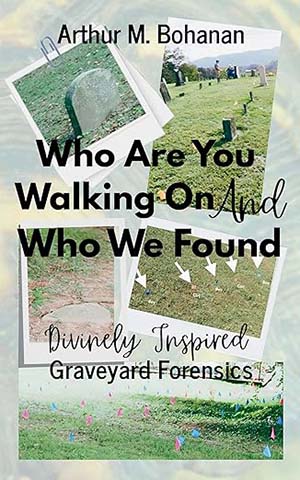
| This book details the new forensic method used to find lost graves. This is one of 20 books authored by Forensic Specialist Arthur Bohannon |
Cemeteries are often forgotten and abandoned for various reasons, such as when TVA began introducing hydroelectric power to the area, bringing a deluge to many low-lying areas.
A cursory examination of the gender ball reveals some metallic components. Bohannon refuses to disclose the inner workings of the object and said he would never get it patented.
“I demonstrated it to a businesswoman who asked how it worked. Then she said she would make money off it,” Bohannon said. “I turned her down. I don’t accept fees for locating graves or cemeteries. I won’t get it patented because I want everyone to be able to use it. I want it to serve mankind.”
Bohannon has authored 20 books. His latest book, Who Are You Walking on and Who We Found: Divinely Inspired Graveyard Forensics, tells the story of this research and how it came to fruition.
