
Mar 2, 2026, 11:33 am
 |
|---|
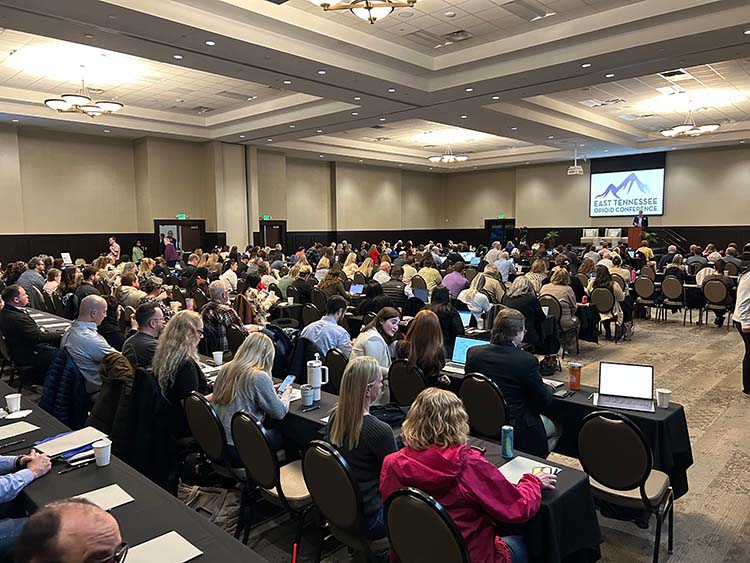
| Metro Drug Coalition’s 8th annual East Tennessee Opioid Conference. image courtesy of Mayor Jacobs |
KNOXVILLE - For roughly an hour, Chris Thomas talked about drug-related data, what’s tending, the quantifications and possible changes.
The Knox County Regional Forensic Center’s director listed overdose stats, he pointed out death rates, and he told the large audience exactly what illegal drugs are at the forefront of our community.
Often it sounded like complicated math. It was actually about much more.
“These aren’t numbers we’re talking about – these are people,” he said, sitting on a stage along with two of the state’s leading drug task force officers. “We get a lot of credit for keeping up with the trends, but these are really lives that we are talking about.”
Thomas was part of the Metro Drug Coalition’s 8th annual East Tennessee Opioid Conference that took place Thursday inside The Venue at Lenoir City.
During the day-long symposium, professionals from healthcare, education, mental wellness, the legal arena and law enforcement participated in a series of discussions that drew in hundreds and went beyond simple awareness and, instead, focused on real-world, evidence-based strategies designed to find solutions for substance use disorders.
There isn’t an easy answer, officials noted. Such matters impact families, workplaces, schools and healthcare systems across Tennessee every day. Addressing the issues requires constant education, collaboration and action.
That means focusing on such topics as pain management, rehabilitation – not just from drugs but from a rock bottom lifestyle – veteran recovery, new treatments and – yes – looking at the numbers and trends that point the way to drug use, prison time and overdoses.
It’s often challenging and new drugs hit the markets every year or the old ones reemerge.
For example, methamphetamine, marijuana and fentanyl comprised the top three drugs seized by the state for a combined 17,000 pounds in 2024, said Mark Delaney, a 26-year law enforcement veteran and the special agent in charge of the TBI’s Dangerous Drugs Task Force. But oxycodone rounded out the Top 10 list this time around, replacing psilocybin.
He said overdose deaths jumped 87 percent during the 20-year span between 2000 and 2022, and that fentanyl use increased from 2019 to 2024.
However, there is some good news.
Delaney noted that between 2023 and 2024, OD deaths dropped close to 32 percent and fentanyl use dipped.
He attributed the positive changes to education programs, increased prescription drug monitoring and drug disposal programs.
“We can’t always arrest ourselves out of the problem,” Delaney added.
In Knox County, meth and heroin are now more prevalent.
“If you ever told me (those drugs) would be a problem in East Tennessee, I would have told you that you were crazy,” said Knoxville Police Lt. Josh Shaffer, who supervises the Organized Crime Unit within the Investigations Bureau. “Unfortunately, I was proven wrong.”
Shaffer said the RFC helps his team combat the drug problem, helping officers track the center’s overdose records and see if district attorneys can prosecute.
“The work (the RFC) does is amazing – our forensic center is on the cutting edge and I’m just saying that because they’re here,” he said. “That’s the viewpoint from the rest of the country.”
Shaffer pointed out that several years ago when bromazolam and xylazine hit local streets, RFC officials worked with the state General Assemble to implement new laws that helped lower the drugs’ presence.
“Unfortunately, the drug market is always changing but the RFC is on top of it,” Shaffer said.
Recently, a new synthetic opioid hit East Tennessee in late October. As of mid-February, the same designer drug was linked to a combined 28 deaths, according to preliminary toxicology tests.
The new drug is called N-Propionitrile Chlorphine, or cychlorphine for short, and is a non-fentanyl-related synthetic opioid. It originated in China in 2024 and quickly moved to Europe before hitting the United States in the fourth quarter of 2025. Although only nine states across the country claim to have seized the new drug, the numbers are deceptive.
“I hear people say Knox County has a big drug problem but that’s not exactly true – we have the best surveillance,” said Thomas, adding that the RFC and state agencies test for cychlorphine while other states either don’t or can’t.
That’s expected to change, though.
“Technology will help diagnose trends,” Thomas said. “A decade ago, drug testing strips were not advanced enough to detect fentanyl and now they are.”
