
Tennessee DA's Warn of Growing Online Child Exploitation
November 16, 2026, 2:59 p.m.
NASHVILLE, TN - Children across Tennessee face growing risks of online exploitation as predators use social media, gaming platforms and digital devices to target young victims. District Attorneys General are urging parents and caregivers to remain vigilant and understand the warning signs of Internet Crimes Against Children (ICAC).
In the 9th Judicial District, investigators Cortney Dugger and Chanel Finnell dedicate their work exclusively to identifying online predators, protecting victims, and brining online offenders to justice. They recently uncovered a case involving a local 15-year-old who was being sextorted for $700.
9th Judicial District ICAC team at a forensic work station. "There's so much of it. Nobody thinks this is going to happen to them or their kid," said Investigator
Cortney Dugger. “We prioritize what we feel are the most dangerous offenders first.”
In many sextortion cases, predators pose as children online, using gaming platforms and social media to establish relationships with young victims. They build trust and then request explicit images or videos. Victims are then threatened with having those images released to acquaintances unless they pay money.
Established in 2009, the district's specialized ICAC unit spends countless hours examining digital evidence, sometimes sorting through millions of messages to uncover criminal activity.
"Children are giving up their souls – their identities – through videos and pictures," said 9th Judicial District Attorney General, Russell Johnson. "It has a lifelong impact on the victim. It changes their trajectory – the course of their life – going forward, so it's absolutely important that we do everything we can to put a stop to this."
How Children Are Being Targeted
Dugger and Finnell say many predators today are creating fake online accounts, pretending to be a younger person. They will first try to reach children and teens through an open setting on applications or online games, with the goal of enticing that child to have a conversation with them on a private setting. Predators will sometimes offer the child money, such as online gift cards or in-game purchases, as a means of becoming their friend. They will often use casual conversations and compliments, a strategy known as grooming, to cultivate an online relationship with that child. This can lead to later requests of nude photos of the child, nude videos, and/or requests to meet the child in person.
“Kids are just on their phones. Their phones never leave their hands or their tablets,” said Finnell. “There is just constant access, which is almost like someone out there has constant access to you.”
“They’ll [online predators] get that child to send compromising photos or videos to them,” said Dugger. “Once they do, they’ll say ‘Hey. I’ve got your videos and I’ll need you to pay me, or here’s a list of your family that I found on your Instagram. I’m going to send this [compromising photo] to Grandma. Here’s her name. I’m going to send this [compromising photo] to Mom. Here’s her name.’ These people have done their research,” added Dugger. “They get this information that is readily available on the internet.”
Often times children are too embarrassed to come forward and tell their parents or report the incident to local law enforcement.
“My biggest fear is a juvenile harming themselves because of the actions they’ve done,” said Finnell. “Kids are ashamed that they’ve sent these pictures to some guy that they thought they knew and feel guilty.”
The 9th Judicial District receives many ICAC tips from the National Centers for Missing and Exploited Children, the nation’s largest center focused on helping find missing children and combat child sexual exploitation. In 2025, the NCMEC says it received 21.3 million cyber tipline reports nationwide.
ICAC Prosecutions & Law Enforcement Training
Tenessee’s 6th Judicial District (Knox County) has three full-time prosecutors dedicated to child abuse, neglect, and ICAC cases. District Attorney General Charme Allen's office also provides specialized training to prosecutors, investigators, and community partners statewide. Last April, Assistant District Attorney, Ashley McDermott, presented an ICAC training session to law enforcement at a TNDAGC Conference.
"A lot of times what we have preached is stranger danger,” said Assistant District Attorney McDermott. “If you meet someone over the internet, you don't know them. They're a stranger. But for kids, the way they act on the internet now, people have friends that they have never met before on the internet. That could potentially be their best friend."
ADA Ashley McDermott presents at ICAC training session in April, 2026.
The ICAC threat extends across the state. In the 1st Judicial District, the Johnson City Police Department has assigned an investigator exclusively to ICAC cases. The department also recently added K9 Buck to the team, a specially trained electronic storage detection dog that can locate hidden devices. Those electronics are critical evidence in ICAC cases with mountains of digital evidence that investigators comb through.
"In these cases, there are multiple, multiple search warrants," said Gen. Finney, District Attorney of the 1st Judicial District. "There are subpoenas to different agencies, such as Verizon, to get the information that we need on multiple devices. It has to be tracked form the source. If you don't have that piece, you can't prosecute the case."
Prosecuting ICAC Cases
With an influx of cases, in 2009 the 9th Judicial District decided to create its own ICAC investigative unit. Since then, the caseload has been never-ending.
“Children are giving up their souls, their identities, through videos and pictures,” said District Attorney General Russell Johnson of Tennessee’s 9th Judicial District. “It has a lifelong impact on the victim. It changes their trajectory, the course of their life going forward, so it’s absolutely important that we do everything we can to put a stop to this.”
Gen. Johnson says Dugger and Finnell spend countless hours every week combing through mountains of digital evidence to track down suspects.
“Sitting on my forensic workstation, I’ve got one [case] where there’s over 20 million messages just in one person’s account,” said Dugger. “So, part of our job is to sift all that out. We’re looking for the illegal content in just say 20 million messages.”
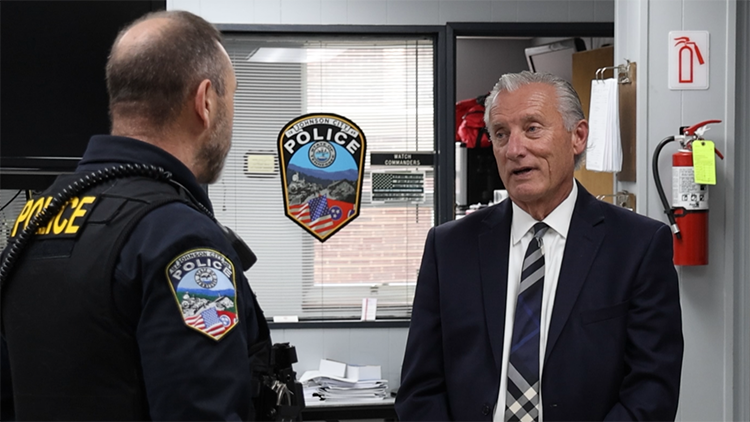
140 miles east of Roane County, in Tennessee’s 1st Judicial District (Carter, Johnson, Unicoi and Washington Counties), District Attorney General Steve Finney says his office is also seeing an increase in ICAC cases. He spoke with us alongside Johnson City Police Chief, Eric Dougherty.
 |
|---|
| Gen. Finney & JCPD Chief Dougherty. Image by Tennessee District Attorneys General Conference (TNDAGC) |
“We have specifically assigned one investigator out of our Special Victims Unit to work nothing but Internet Crimes Against Children,” said Chief Dougherty. “The case load is high. Primarily on the search warrants, looking for SD cards, the hard drives, things of that nature.”
“In these cases, there are multiple, multiple search warrants,” said. Gen. Finney. “There are subpoenas to different agencies, such as Verizon, to get the information that we need on multiple devices. It has to be tracked form the source. If you don’t have that piece, you can’t prosecute the case.”
To help locate electronic evidence, the Johnson City Police Department recently added K9 Buck to their unit. Buck specializes in electronic device detection and has been trained to alert to (sniff out) a chemical compound found in all electronic storage devices, including micro-SD cards, flash drives, phones, tablets and computers. All are critical evidence in prosecuting ICAC cases.
“People use the phones and internet to engage in child exploitation, and they tend to take measures that it [the device] won’t be located. We have to think outside the box,” said Sgt. Tim Hensley with the Johnson City Police Department. Sgt. Hensley is K9 Buck’s handler.
During a training demonstration for the TNDAGC, K9 Buck located a USB flash drive that was hidden inside a dishwasher unit soap dispenser. He also found an SD card hidden inside a large soda machine, and a cell phone hidden inside a couch.
“We don’t think to cut open couch cushions on a search warrant,” said Sgt. Hensley. “Buck’s alert can put us in that right direction. He [Buck] is able to be the voice for those children who are exploited.”
Training More Prosecutors in a Growing ICAC World
Statewide, the TNDAGC is also focused on offering important training for prosecutors and investigators who are handling ICAC cases. In April, dozens gathered in Knoxville to learn directly from ICAC Prosecutors in the 6th Judicial District (Knox County). Assistant District Attorney Ashley McDermott was among those speaking at the conference.
“I want them [prosecutors] to know that we have to think about where kids are coming from now, because we have to explain to the jury how things are different than what the jury’s expectations might be,” said ADA McDermott. “A lot of times what we have preached is ‘stranger danger.’ If you meet someone over the internet, you don’t know them. They’re a stranger. But for kids, the way they act on the internet now, people have friends that they have never met before on the internet. That could potentially be their best friend.”
The 6th Judicial District has three full-time prosecutors devoted to handle only Child Sex Abuse, Child Physical Abuse, Child Neglect, and Internet Crimes Against Children cases.
“It’s sad when you think about it. That we need three full-time prosecutors to handle that volume just for Knox County,” said District Attorney General, Charme Allen, of Tennessee’s 6th Judicial District. “We take that experience and share. My prosecutors do training not only with other district attorneys’ offices throughout the state. They train law enforcement officers; county, state, federal. They do training in our local schools. In our churches,” added Gen. Allen. “It is our job as parents and it’s our job as prosecutors to protect those vulnerable victims.”
Dugger says that he and Finnell have also received special training to do covert online investigations. They have created online accounts, posing as children, then wait for suspects to reach out to those accounts.
“My first account that I made, I was a young female living here in Roane County,” said Dugger. “It took seconds for people to start private messaging to have private conversations. Seconds. Seconds.”
Source: Tennessee District Attorneys General Conference (TNDAGC)
