
Richer People Have an Edge When It Comes to Getting National Park Permits
By University of Colorado Boulder
October 7, 2026, 11:38 a.m.
 |
|---|
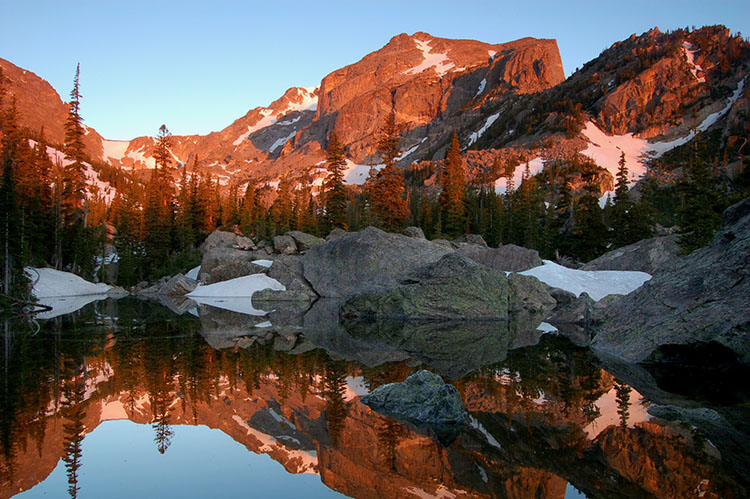
| Hallet's Peak reflected in Lake Haiyaha at dawn in Rocky Mountain National Park; image by National Park Service |
• As Rocky Mountain National Park prepares to end its timed entry system for the season, a new study shows that higher-income people are more likely to secure permits.
• Several national parks, including Yosemite and Glacier, introduced permit systems as visitation surged following the COVID-19 pandemic.
Read the story | See the study
Newswise — Many outdoor enthusiasts have spent hours in front of a computer, racing to reserve a campsite, backpacking permit or national park entrance ticket. A recent study suggests that the way these reservation systems are designed can favor higher-income visitors.
In a paper published in Nature Communications, CU Boulder economist Jonathan Hughes found that people from higher-income neighborhoods in the United States are more likely to successfully secure the most competitive permits, including timed-entry reservations for Rocky Mountain National Park.
“The parks are trying to come up with ways to manage finite resources,” said Hughes, professor in the Department of Economics and a fellow at the Renewable and Sustainable Energy Institute (RASEI). “But if you look at the founding document of the Yellowstone National Park, our first national park, it is to be ‘ set apart as a public park…for the benefit and enjoyment of the people,’ not just rich people.”
National parks in the United States have seen steady increases in visitors since around 2013, with the COVID-19 pandemic pushing visitation even higher in recent years.
Crowds can put pressure on park infrastructure, impact the ecosystem and make emergency response more difficult. In response, many parks have introduced online reservation systems for parking, popular trails and entering the park at certain times.
Hughes examined 11 reservation systems covering more than 5 million reservations at seven national parks, including Rocky Mountain National Park, Glacier National Park and Yosemite National Park.
By tracking the ZIP codes associated with reservations, he found that among systems that offered advanced reservations, visitors who secured permits weeks or months ahead tended to come from higher-income areas than those who obtained permits the same day or a day in advance.
Particularly for highly competitive permits, where most tickets sell out within five minutes after they become available, successful reservation holders came from ZIP codes with median household incomes about 3% to 6% higher than those associated with less competitive reservations.
Hughes said this could be because higher-income visitors have more flexibility to plan trips months in advance, are more familiar with the reservation system and tend to be more tech-savvy.
"Education, age and race could also play a role," Hughes said. "Any indication that some people have better access than others runs counter to the goal of giving everyone equal access.”
