
October 13, 2026; 4:28 a.m.
 |
|---|
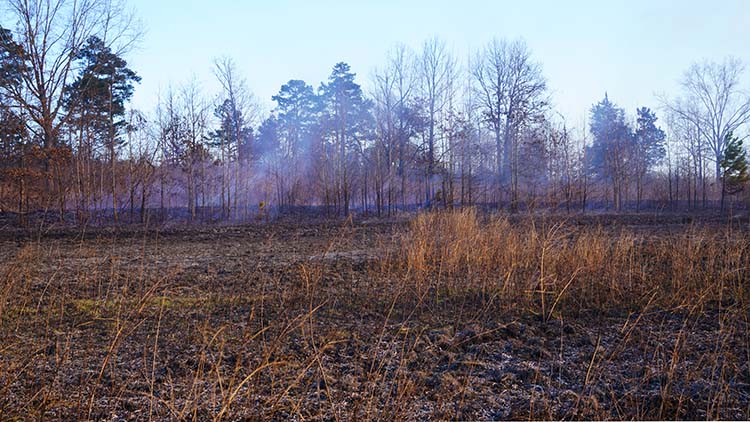
| Controlled burns are an essential part of restoring quail habitat, transforming foliage-dense areas into open savannas the birds need to thrive. Photo by T. Cronin, courtesy UTIA |
GRAND JUNCTION, TN - Multiple coveys of wild bobwhite quail were recently sighted at the University of Tennessee’s Ames AgResearch and Education Center, marking an encouraging milestone in an ongoing effort to restore habitat for the species at this historic bird dog field trial destination.
The sighting comes during the second year of a conservation partnership between UT AgResearch and Tall Timbers, a nonprofit organization specializing in natural resource research and education. Together, teams are restoring bobwhite habitat across more than 5,000 acres of bird dog competition grounds at the Center, home of the National Championship for Bird Dogs, which attracts thousands of visitors annually.
In recent years, pen-raised birds have been released for competitions since wild quail populations are too low to support the events. “We cannot expect pen-raised quail to establish a permanent population,” says Alex Jackson, Tall Timbers’ Mid-South regional program director. “Instead, we must alter thousands of acres to ensure this future habitat is suitable for successful population persistence.”
Since the project began in 2025, approximately 1,500 acres at the Center have been managed through a combination of tree thinning, mulching, and prescribed fire. These practices are transforming dense, closed-canopy forests into an open savanna with the diverse vegetation and structure bobwhites need for nesting, brood-rearing, and year-round survival.
In areas where remaining quail populations are deemed too low to appropriately respond to habitat restoration, Tall Timbers teams use translocation, or moving wild birds from one location to another. At Ames, a multiyear translocation process will be an important tool for accelerating population recovery and supporting the many amateur and professional bird dog competitions held annually.
“Bobwhite quail are Tennessee’s official state game bird and an enduring part of our state’s natural and cultural heritage,” says Matt Backus, director of the Ames AgResearch and Education Center. “Much of this history is centered at Ames, which has hosted the National Championship for Bird Dogs since 1915. After the initial restoration process, ongoing property management will ensure our efforts support conservation for decades to come.”
Long-term management will include annual prescribed burns across approximately 50% of the field trial courses, as well as herbicide applications to control undesirable and invasive plant species. A year-round supplemental feed program will support birds during winter, while predator management during the summer nesting season will help improve reproductive success.
“Bobwhite quail are often considered an umbrella species, meaning that conservation efforts to improve their habitat can benefit many other species as well,” says Jackson. “Thus, restoring this ecosystem is of broad value for both humans and wildlife. It is our collective responsibility to ensure the legacy of bobwhite lives on while creating another conservation success story for Tennessee.”
The project will continue in the coming years, with the timeline for completing the restoration phase dependent on timber markets, weather, and costs. The second phase of the project will then focus on using the Center as a focal point for improving awareness of regional bobwhite conservation and the benefits of prescribed fire in ecosystem health.
Field days and educational events have already been held and will expand in the coming years, connecting project leaders with landowners and organizations interested in assisting wild bobwhite populations across Tennessee and the Mid-South.
The University of Tennessee Institute of Agriculture is comprised of the Herbert College of Agriculture, UT College of Veterinary Medicine, UT AgResearch and UT Extension. Through its land-grant mission of teaching, research and outreach, the Institute touches lives and provides Real. Life. Solutions. to Tennesseans and beyond. utia.tennessee.edu.
