
Knox County RFC Team Member Reflects on 9/11 Search and Recovery Role
September 13, 2026, 8:58 p.m.
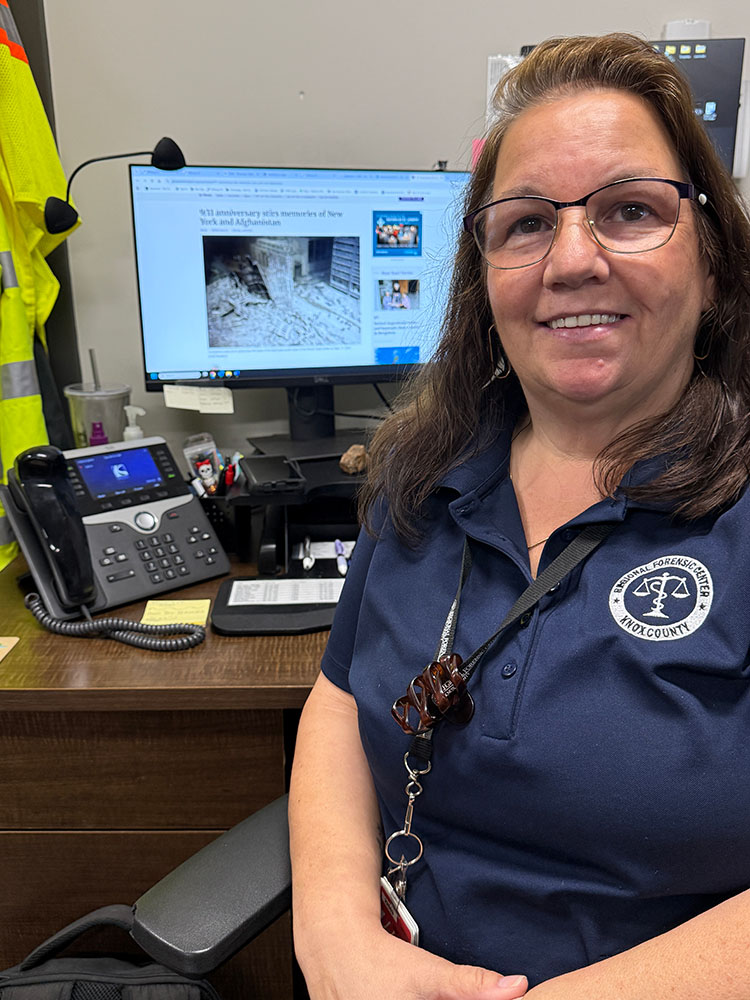 |
|---|
| Chris Hawley, a 9/11 first responder at the World Trade Center's Twin Towers. Image by Knox County Regional Forensic Center |
KNOXVILLE - Five days after al-Qaeda terrorists flew two hijacked airliners into the World Trade Center’s Twin Towers, Chris Hawley stood in front of what New York’s first responders would later dub “the pile.”
The job, she thought, was search and rescue. It wasn’t. It was search and recovery.
The attacks killed almost 3,000 that dark morning on Sept. 11, 2001. And there was no one left to save.
The monstrous mountain of twisted steel and pulverized concrete before her was intimidating. It was overwhelming, surreal, eerie, and horrific. The fires continued, and the smoke made breathing almost impossible.
The first time she entered deep into it, someone threw her a black Sharpie and told her to write her name, next of kin, and contact information on her arm – just in case she didn’t make it back.
“We were working in a burning tomb,” she says from her office at the Knox County Regional Forensic Center where she serves as a senior lead Medicolegal Death Investigator. “The respect and somberness of the situation was palpable.”
She felt helpless; she felt hopeless. The emotions affected everyone there.
“When I first arrived, there was still hope that we were going to find living people,” she says. “We quickly learned that wasn’t the case. That changed the entire atmosphere at the pile. We felt defeated. We felt beaten.”
Still, she and dozens of other volunteer MDIs, forensic pathologists, firefighters and EMTs pushed on. She assisted families at the family advocacy center, and she obtained demographic information for the missing. Two days into her six-week-long stay, she joined the recovery team.
Each day she slowly passed high-rise buildings that stood without a single light on inside. She meandered around the papers, dust, office supplies, cars, bicycles, and more that littered the streets. She saw everything – except people.
“I cannot begin to explain the eerie feeling of a silent city, especially one as big and loud as New York typically is,” she says. “Downtown Manhattan was deserted and silent. It felt like the end of the world and only you and whoever you walked with at that time were left on the planet. The darkness was so overwhelming. You felt so alone.”
Her job was extremely physical. She carried buckets, climbed steel, sifted through concrete and debris, twelve hours on; 12 hours off. The team moved 1.5 million tons of rubble in 5-gallon buckets – one at a time. They dug deeper and deeper into the pile, looking for voids and pockets.
Once, she fell, striking her face on a piece of metal that left her with a black eye. Her team was tired, bruised, and hurt each day. But that wasn’t the worst pain.
“Emotionally – that was the biggest struggle,” she says. “The intrusive thoughts that you didn’t do enough – the images that you cannot get out of your head of the site, the victims, the families searching for their loved ones.”
Chris also battled her own personal struggles. She and her family lived on a military base, so life changed there, too. Bases locked down, threat levels increased, movements restricted. Her own daughters missed their mom and worried that dad – who served in the military then – could leave for war.
This year marks the 25th anniversary of the attacks and still decades later, Chris, who investigates deaths across the region for the RFC and helps coach other investigators, still lives with loss, nightmares and survivor’s guilt.
“Since 9/11, I have suffered from PTSD, and I still have trouble sleeping,” she says. “I still have anxiety attacks that become more frequent as September approaches. There is still the guilt living in my head that we were not able to save anyone. The visions of family members who would come to the entrances of Ground Zero, holding up photographs of their missing loved ones and begging me to find them and bring them home, still haunt me. The look of desperation and fear on their faces, and then the thoughts in my own head – in knowing that there were no survivors and I wasn’t going to be able to help them still gives me nightmares.”
Chris has worked for the Knox County RFC for eight years and served in the field for 28 years. She and RFC Communications Director Mike Donila talk more about her role in the days and weeks following the Sept. 11, 2001, attacks in a Q&A below.
Please talk about what you were doing at the time and how you got involved: I was in a courtroom and the judge left for about 30 minutes before returning and instructing us all to untuck our shirts and show the bailiff our waistbands. The judge then announced that the United States was under attack. My Chief Deputy Coroner was in Washington, D.C. trying to get money on Capitol Hill and they sent him to the Pentagon to assist. I was then asked if I would volunteer in New York, so I drove straight there.
How does the anniversary of 9/11 affect you each year and does the 25th anniversary create more or any less anxiety for you: As the anniversary approaches, my nightmares become more frequent. I become more irritable and I think a lot of that has to do with the images shown on TV and social media. The videos of the planes striking the towers are the worst. I cannot imagine how the families of the victims feel watching those images over and over. With the 25th anniversary approaching, I find myself thinking more about those families and how much must have changed for them in the last 25 years. Births, weddings, anniversaries, etc., and I am hoping they have found a way to find some happiness.
What’s been the hardest part for you: I think each anniversary gets a little harder. In the early years, I learned how to shut my feelings and emotions off or maybe just bury them deeper and deeper. As I get older, it does get harder to ignore my feelings, so I am having to face those emotions that I buried for the last 25 years.
Why did you go and knowing what you know, would you do it again: I went because I wanted to help. I had a specific skill set that I thought would be needed. There are days I am glad that I went and was able to help in some small way, and there are days when I struggle with PTSD or hurtful feelings that really weigh on my mind. But, knowing what I know now, I believe that I would have still gone. I have made a career out of helping families find answers and I feel that I played a very small role in helping the families involved.
What is the one thing you will never forget: One of the most haunting images that I cannot get out of my head isn’t a gruesome body; it isn’t the mangled steel; it isn’t the darkened city. It’s the image of a veteran firefighter sitting at a Salvation Army food truck picnic table with a full plate of food in front of him, and his face buried in his hands. And, when he looked up at me there were tears rolling down his cheeks, devastation in his eyes. He sat there and just held my hand while he tried to eat. We didn’t know each other but we both knew what the other had just seen that day. I have seen that firefighter’s face almost every night when I close my eyes and try to sleep.
